What makes a Morocco tour cultural
Morocco has four imperial capitals — Fes, Meknes, Marrakech and Rabat — and a tour that visits two or three of them covers roughly nine centuries of building, from the Almoravid walls to the French protectorate. That is the backbone of a cultural route.
Around it sit three other kinds of stop. Volubilis, outside Meknes, is the Roman town whose mosaics are still in the floors where they were laid. Chefchaouen, in the Rif, is the blue-washed town founded in 1471 and now the most photographed street scene in the country. And the kasbah valleys south of the Atlas — the Dades, the Todra, the road through Aït Ben Haddou — are where mud-brick architecture is still lived in rather than preserved.
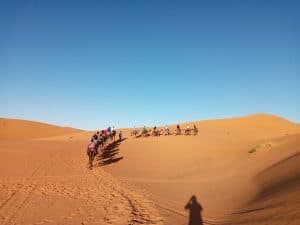
Most of the itineraries below combine the cities with a night in the Sahara, because the road between Fes and Marrakech runs that way. If the desert is what you are really after, start instead from our Morocco desert tours.
Volubilis, Meknes, Rabat and Chefchaouen
Volubilis sits on a shelf of farmland about 30 km north of Meknes. It was the Roman administrative centre of this corner of North Africa, and what survives is a street plan you can walk: the basilica, the triumphal arch, and the mosaic floors of the merchant houses, left open to the sky.
Meknes is the quietest of the imperial cities and the easiest to read. Moulay Ismail made it his capital in the seventeenth century and built on a scale that still looks excessive — the Bab Mansour gate, the granaries and stables, kilometres of rampart.
Rabat is the working capital on the Atlantic. The Hassan Tower and the Chellah necropolis are the two sights that carry the history; the Kasbah of the Udayas, blue and white above the river mouth, is the one people remember.
Chefchaouen is three hours south of Tangier in the Rif mountains. The blue is the point, and so is the pace: it is the one stop on most of these routes where the plan is to walk and look rather than drive on.
How many days do you need?
Two days covers one corridor and no more — Fes to Chefchaouen by way of Volubilis and Meknes is the short cultural route, and it works because the distances are small.
Four to five days is enough for two imperial cities plus either Chefchaouen or a first night in the desert, usually as a one-way crossing rather than a loop.
Seven to nine days is where the cities stop feeling rushed. You can take Rabat and Meknes properly, give Fes a full day, cross the Atlas and still reach the dunes.
Ten days to two weeks adds the south: the kasbah valleys, the Atlantic coast, and time that is not spent in a vehicle. If you are weighing this up, our guide to how many days you need in Morocco works through the trade-offs.
What these tours have in common
- Every itinerary reaches at least two of Volubilis, Meknes, Rabat and Chefchaouen
- Fes, Meknes, Marrakech and Rabat: Morocco's four imperial capitals
- Volubilis, the Roman town whose mosaics are still in the floors where they were laid
- Chefchaouen, the blue-washed town in the Rif
- The kasbah valleys south of the Atlas
- Each is a private tour with a dedicated driver
- Every route can be adapted to your dates and group
Cultural tours in Morocco: common questions
Which cities are Morocco's imperial capitals?
Fes, Meknes, Marrakech and Rabat. Each was the seat of government under a different dynasty, which is why their monuments look so different from one another. Most of the tours on this page reach two or three of the four.
Can a cultural tour also include the desert?
Yes, and most of these do. The natural road between Fes and Marrakech crosses the Atlas and passes the dunes, so a cities-and-Sahara route is the normal shape rather than a compromise. The shorter northern routes — Fes to Chefchaouen, Tangier to Chefchaouen — stay in the north.
How much walking is involved?
The driving is done for you; the sightseeing is on foot. Medinas in Fes and Meknes are closed to vehicles, Volubilis is an open archaeological site, and Chefchaouen is built on a slope. Comfortable shoes matter more than fitness.
Are these tours private?
Yes. Every tour listed here is private, with a dedicated driver, and the itinerary can be adapted to your dates and group.
When is the best time for a cultural tour?
Spring and autumn suit the cities best — summer in Fes and Meknes is hot, and the Rif can be wet in midwinter. Our month-by-month weather guide sets out what to expect.